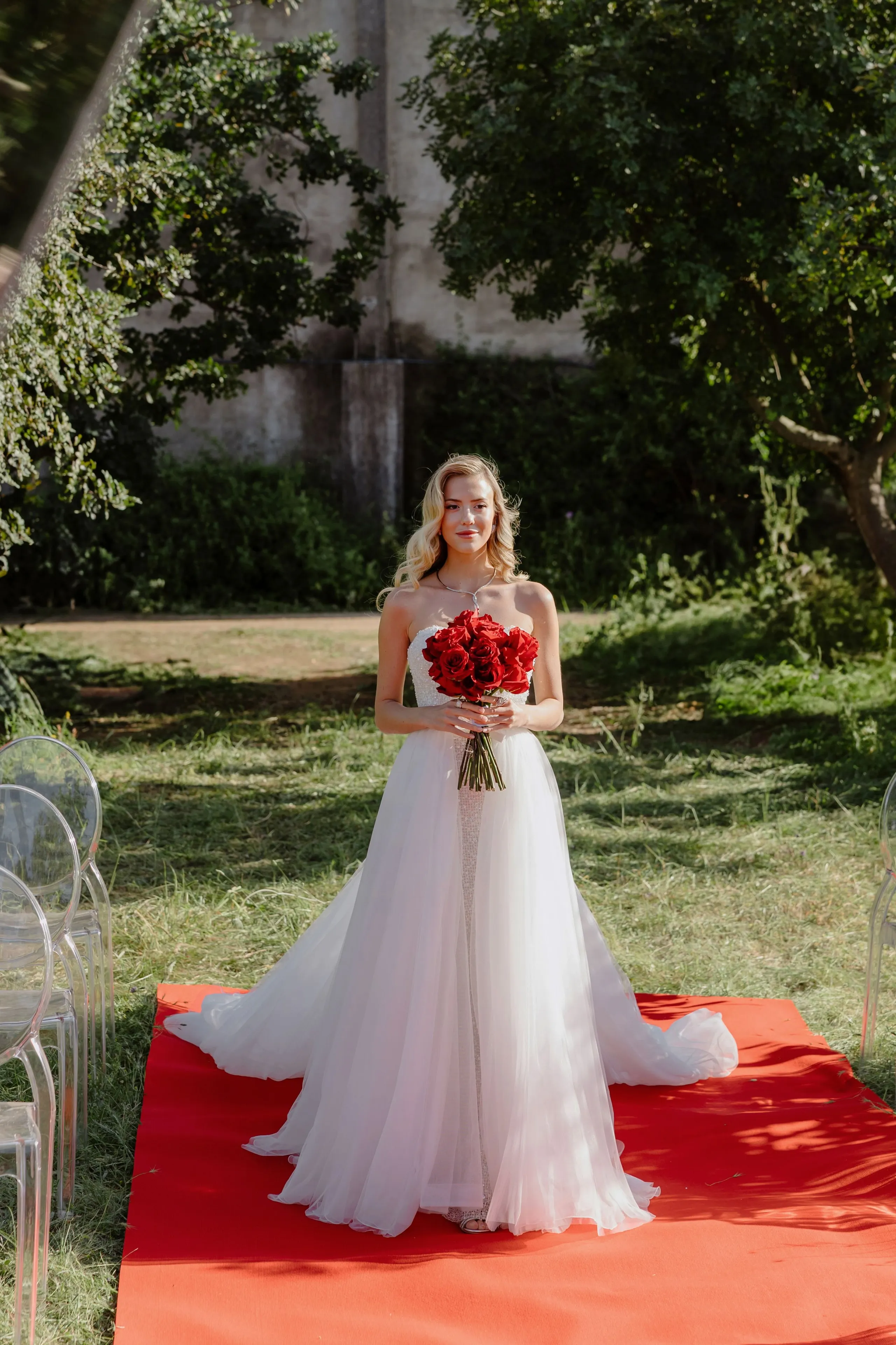
A wedding in Greece already has its setting: stone, sea, olive trees and a light that flatters everything. Flowers should frame all of that, not compete with it.
Here’s what we tell couples from our workshop in Crete, usually before we’ve sketched a single arrangement.
Start with a planner
The weddings we’re proudest of almost always had a planner who knew the venue well, understood what the couple wanted and made sure the flowers, lighting, tables and everything else worked together.
Destination weddings are much easier with someone local who has done this many times. A good planner knows the people at the venue and the suppliers, and sorts out most problems before you ever hear about them. On Santorini and Mykonos, many venues expect you to have one.
When to book
For a wedding between May and October, we’d suggest booking your florist nine to twelve months ahead. Saturdays in June and September are the first to go, especially on Santorini. If you have some flexibility, April and late October are quieter and cooler, and they’re among our favourite months for a wedding.
Most couples book in this order: date and venue first, then the planner, then the florist and photographer. Try to bring your florist in before the dress is final, so we can design the bouquet with the dress in mind, along with the season and the time of the ceremony.
Where the flowers come from
Most fine wedding flowers in Greece, including garden roses, ranunculus, peonies and lisianthus, start out at the Dutch flower auctions. They reach Greek wholesalers only on certain days of the week, and for an island wedding there’s a ferry crossing on top of that.
So we have the flowers delivered several days before the wedding. Roses need that time to open, and every stem needs to be conditioned properly. Seasons matter too. Peonies are at their best from April to June, and ranunculus and anemones are spring flowers.
The things that make a wedding feel Greek grow much closer to home: olive branches, lemon leaves, fig, cypress and wild herbs. We use a lot of them.
Bougainvillea looks beautiful on the walls of your venue, but once it’s cut it wilts within hours, so we usually leave it where it grows.
Designing for the climate
Heat
In July and August, afternoon temperatures regularly go above 30°C. Roses, lisianthus, orchids, chrysanthemums and most foliage cope well. So do modern carnations, which have come a long way and are worth a second look. Hydrangea, sweet pea, gardenia and the most delicate garden roses need water, shade or an evening ceremony.
You can still have almost any flower you love in summer. We just plan the design around the heat.
Wind
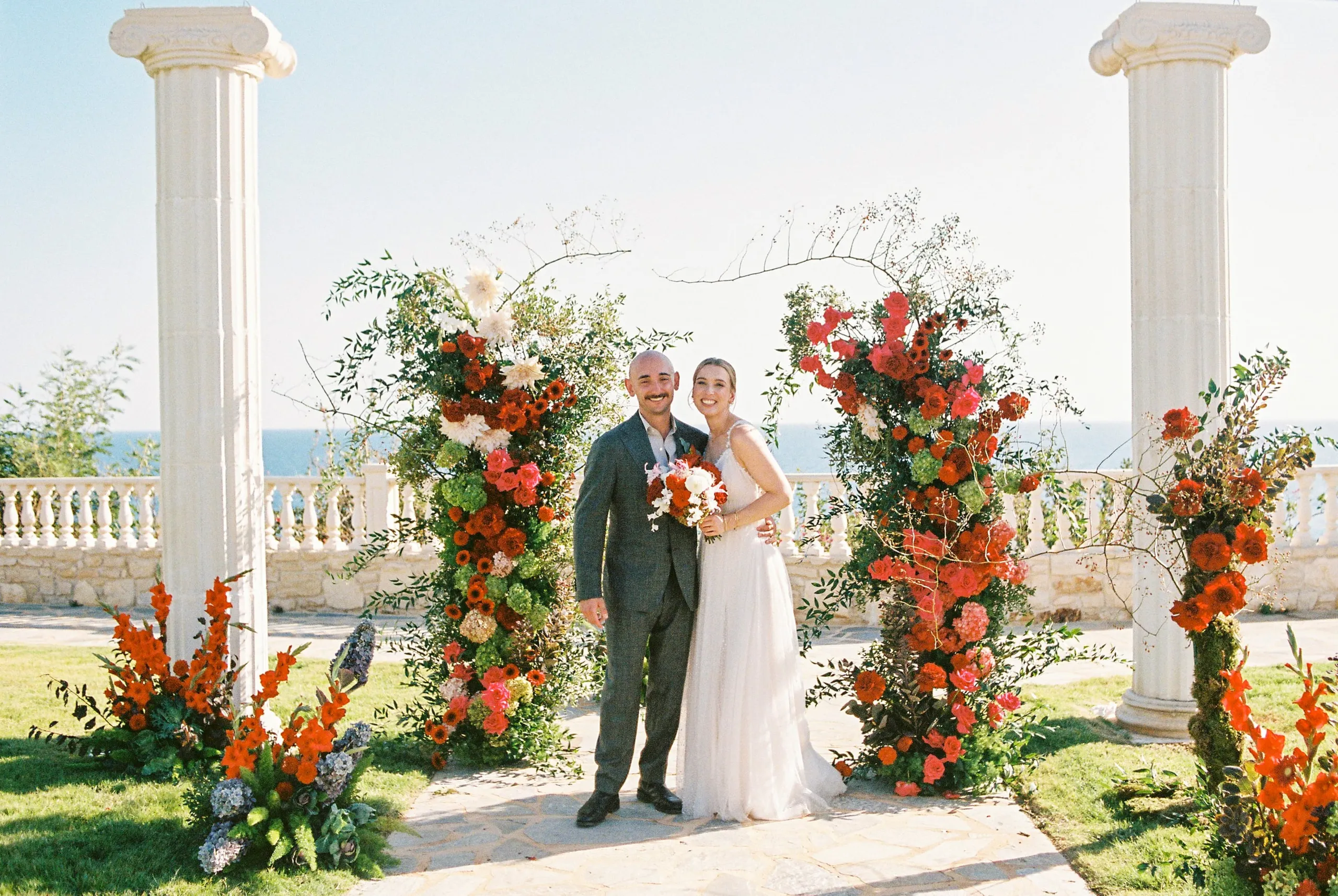
On Santorini, Mykonos and the rest of the Cyclades, the meltemi (a strong northerly wind) is at its strongest in July and August. We build arches heavy and anchor them, keep centrepieces low or weight them at the base, and put every candle under glass.
On the caldera we tend to keep things simple, because no arrangement is going to outshine that view.
Rain
It rarely rains in summer. In Crete and on the mainland, October can bring the odd storm, so it’s worth having an indoor plan and sharing it with your florist well before the day.


Questions to ask your florist
- Where do your flowers come from, and when will they arrive?
- Who handles the setup, and how long do you need at the venue?
- What’s included in the proposal? Delivery, rentals, clearing everything away at the end of the night?
- Which pieces can be moved from the ceremony to the reception?
- What happens if a flower isn’t available that week?
- Have you worked at our venue before?
- Can we see a mock-up of a table?
Where to spend
The ceremony flowers and your bouquet are in every photo, and they’re what you’ll remember. If you’re deciding where the budget should go, put it there.
For everything else, it pays to edit. Ceremony pieces can be moved to the reception, the venue itself can carry the cocktail hour, and one generous arrangement usually makes more of an impression than lots of small ones.
Island travel, rentals and late-night clearing should all be in the proposal from the start, so there are no surprises later.

Your flower timeline
- Twelve months before: date, venue and planner.
- Nine to twelve months: book your florist. Send us a handful of images you love and tell us what drew you to them.
- Six months: we meet, talk through colours and the main pieces, and send you a proposal.
- Three months: we refine the details and make a mock-up if you’d like one.
- One month: final guest numbers and timings.
- Wedding week: the flowers arrive and are given time to rest and open. Bouquets are made the day before or on the morning.
- On the day: everything is set up before your first guest arrives.
Where we work in Greece
Crete
This is home. Olive groves, vineyards, villages and the sea, from Chania to Elounda. Crete has the longest season and the best local foliage.
Santorini
Access to many venues is narrow, the wind is strong and ceremonies are usually timed around the sunset. Book early and keep the design clean.
Athens and the Riviera
Rooftops and seaside estates, with space for larger installations.
We also work on other islands and on the mainland. See wedding flowers across Greece.
Frequently asked questions
- How early should we book a wedding florist in Greece?For a summer Saturday, nine to twelve months ahead. For a weekday or the shoulder season, six months is often enough.
- Do we need a planner?It isn’t required, but a planner makes a wedding in Greece much easier, and many island venues expect you to have one.
- Do you travel beyond Crete?Yes, we work on Santorini, in Athens and across the islands. Travel costs are included in the proposal.
Let's talk
Send us your date, your venue and roughly how many guests you’re expecting. We’ll get back to you with ideas for that time of year and that place.